Long before it became the most heavily regulated consumer product in the United States, tobacco was a sacred plant, a survival strategy for a starving colony, and eventually the engine that built entire cities, financed a war for independence, and created some of the first true monopolies in American business history. Few crops have shaped a nation’s economy, politics, and public health policy as thoroughly as tobacco has shaped America’s.
This is a complete timeline of that story — from the Indigenous nations who first cultivated and revered the plant, through the Jamestown settlers who turned it into the colony’s economic lifeline, to the inventors and industrialists who mechanized it into a global commodity, and finally to the modern regulatory era that reshaped how it’s made, sold, and manufactured today.
Along the way, you’ll find the real dates, the real numbers, and the real deals — from a four-barrel shipment in 1614 to a $206 billion settlement in 1998 — that mark tobacco’s four-century run in American life.
| Era | Key Date | Major Event |
|---|---|---|
| Native Cultivation | c. 6,000 BCE – 1492 | Indigenous peoples grow and use tobacco ceremonially across North America |
| Colonial Cash Crop | 1612 | John Rolfe cultivates sweet tobacco at Jamestown |
| Labor System Shift | 1619 – 1661 | Indentured servitude gives way to chattel slavery in tobacco fields |
| Revolutionary Era | 1776 – 1783 | Tobacco used as collateral and payment to finance the war effort |
| Industrialization | 1880 – 1884 | Bonsack rolling machine mechanizes cigarette production |
| Corporate Monopoly | 1890 – 1911 | American Tobacco Company dominates, then is broken up by the Supreme Court |
| Mass Consumption | 1910s – 1950s | Wartime rations and advertising make cigarettes a daily habit |
| Health Reckoning | 1964 | Surgeon General’s Report links smoking to cancer |
| Regulation Begins | 1965 – 1971 | Warning labels mandated; broadcast advertising banned |
| Legal Settlement | 1998 | Master Settlement Agreement reshapes the industry |
| Federal Oversight | 2009 | FDA gains regulatory authority over tobacco products |
| Modern Era | 2019 – present | Tobacco 21 law, vaping regulation, and a more automated, more regulated industry |
Tobacco’s American story doesn’t start with European settlers — it starts thousands of years earlier. Archaeological evidence suggests tobacco was growing in North America as far back as roughly 6,000 BCE, and Indigenous peoples across the continent had been cultivating, trading, and smoking it for at least 2,000 years before any European set foot on these shores.
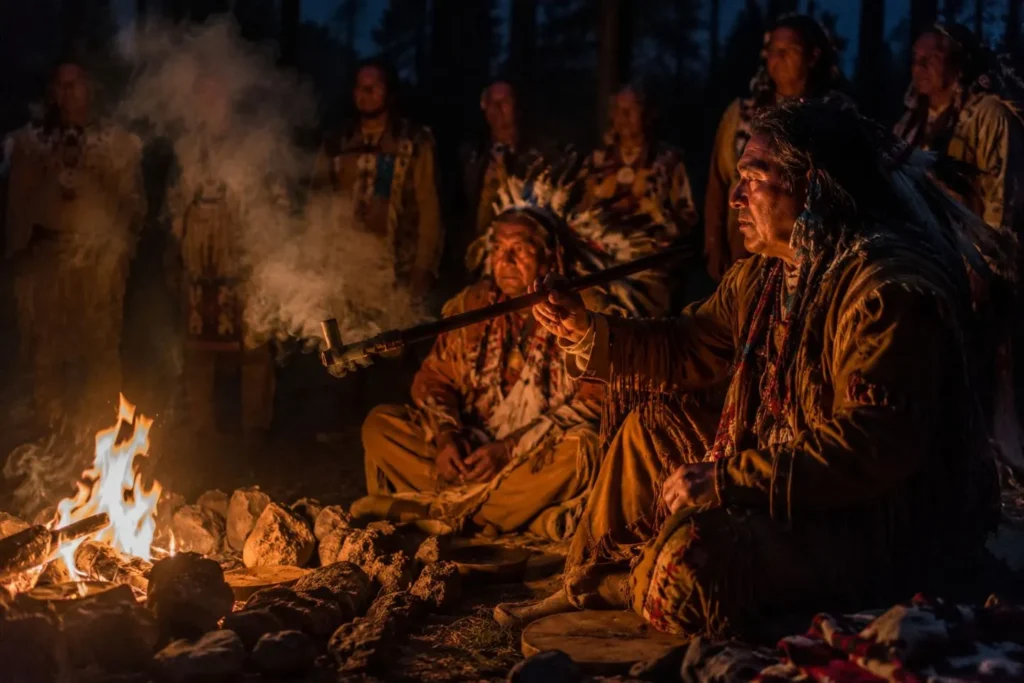
For Native nations, tobacco was never a casual habit. It was used in religious ceremonies, treaty negotiations, healing rituals, and as a gesture of hospitality and peace. When early colonists arrived, tobacco was already woven into the social and spiritual fabric of life across the continent — offered as a gift to visitors, burned in pipes during councils, and used medicinally.
When Christopher Columbus’s crew first encountered the plant in 1492, they had no real frame of reference for it. One of his sailors, Rodrigo de Jerez, is often credited as the first European to smoke tobacco — and reportedly was investigated by the Spanish Inquisition after locals were alarmed at the sight of smoke pouring from his mouth. From Spain, the habit spread across Europe over the following century, well before it became commercially significant in Britain’s American colonies.
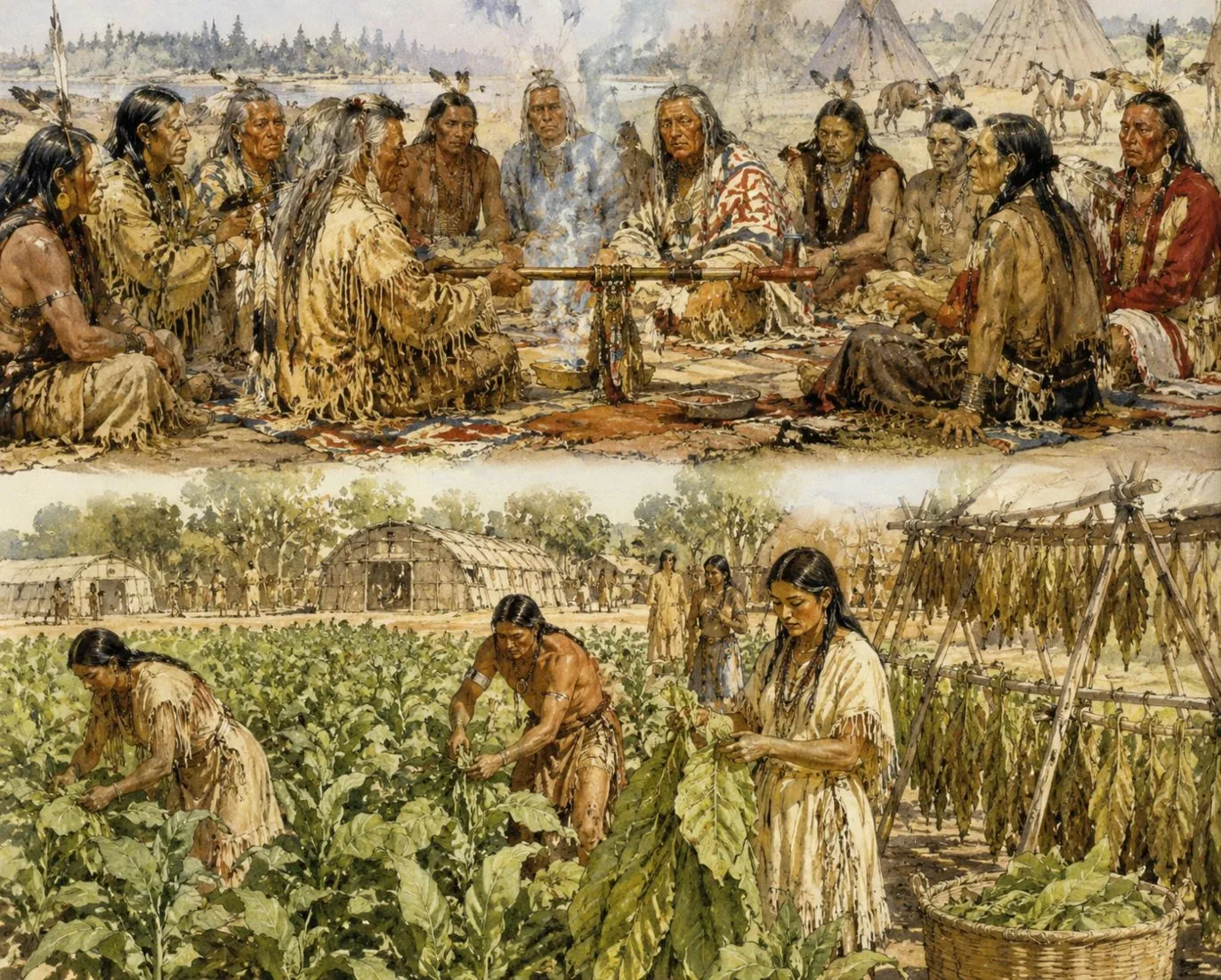
The plant Native Americans grew, Nicotiana rustica, tasted harsh and bitter to English palates and found little market in Europe. The real turning point came when colonist John Rolfe — yes, the same man who later married Pocahontas — got hold of Nicotiana tabacum seeds, a milder strain associated with Spanish colonies in the Caribbean and South America. Spain had made selling those seeds to a non-Spaniard a capital offense, which makes Rolfe’s acquisition of them in 1611–1612 something close to agricultural espionage.
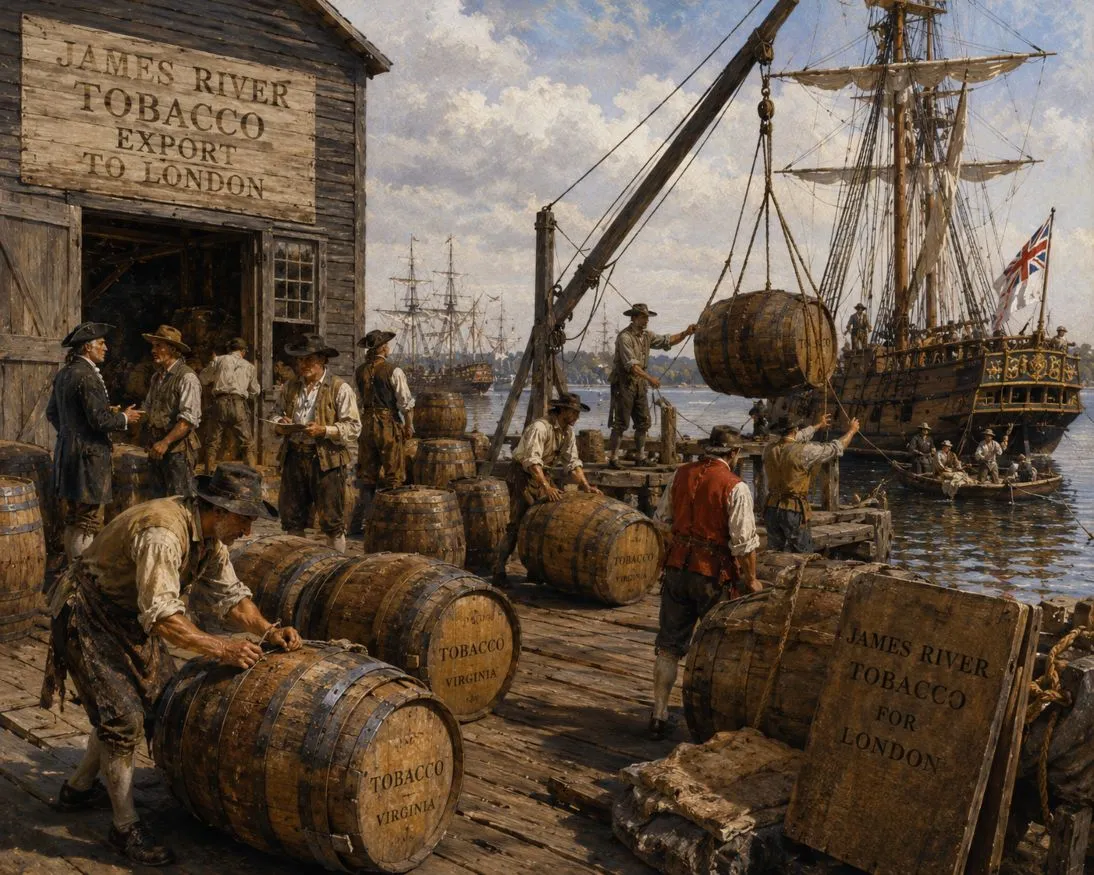
Rolfe planted the new strain at his Varina Farms plantation along the James River and named it “Orinoco.” It worked. The first recorded shipment — four barrels of leaf — reached England in 1614. The numbers grew fast from there:
Jamestown had been on the brink of total collapse just a few years earlier. Tobacco didn’t just rescue it — it gave the entire Virginia Colony its first profitable export and effectively created the economic model that would define the American South for the next two and a half centuries.
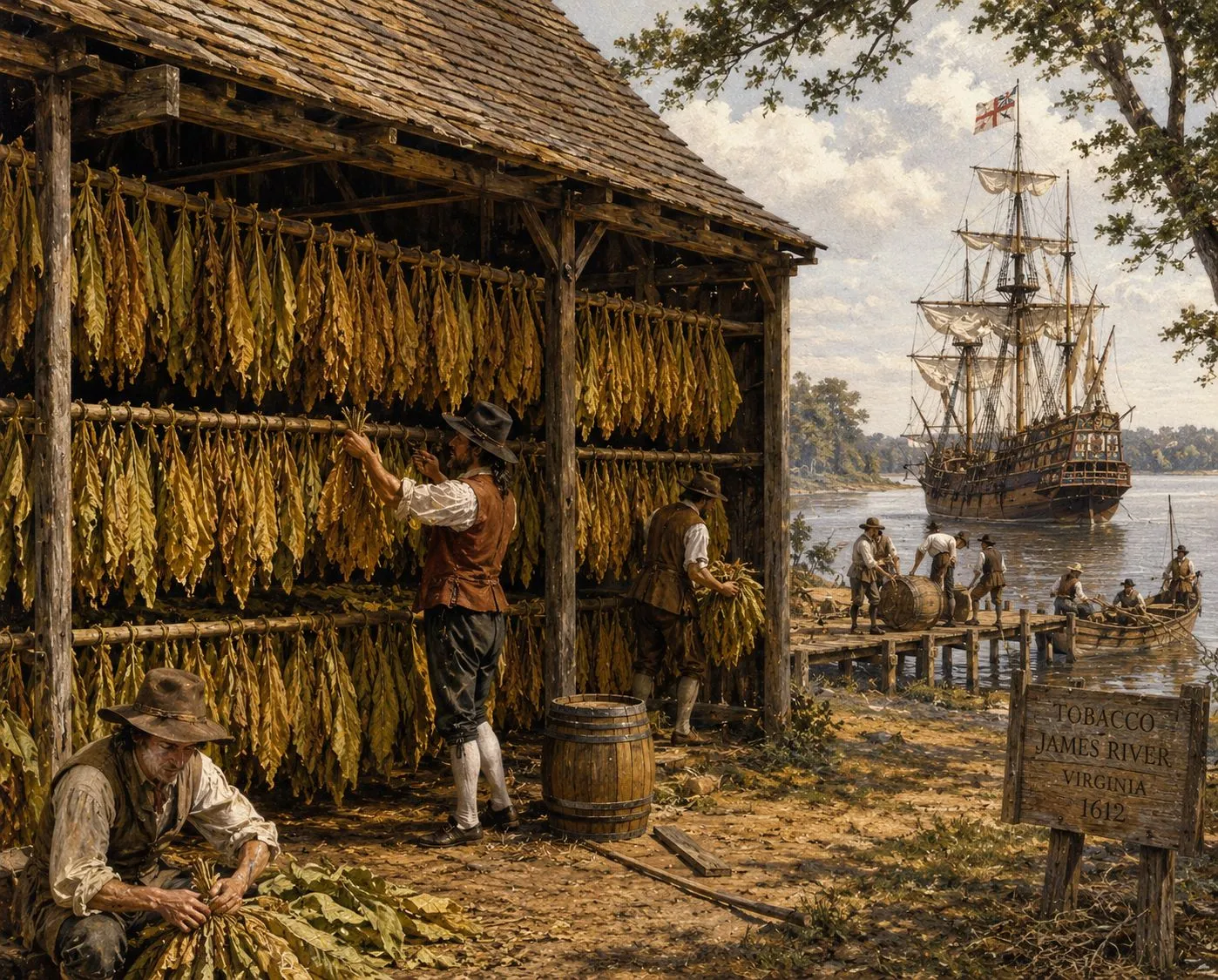
As tobacco became Virginia’s economic backbone, the colony moved quickly to formalize and control it. In 1619, the General Assembly passed the first tobacco inspection law, ordering low-quality leaf brought to Jamestown’s inspection site to be burned outright. By 1620, lawmakers were already capping how many plants a single settler could grow — an early and recurring theme in tobacco’s history: overproduction crashing prices, followed by attempts to regulate supply.
Labor was the other constraint. Tobacco is brutally labor-intensive — clearing land, transplanting seedlings, suckering, topping, and curing all by hand — and the colony solved its labor shortage first through the headright system, which granted 50 acres of land to anyone who paid to transport a laborer across the Atlantic. For most of the 17th century, that labor came primarily from English indentured servants who worked a fixed term (commonly seven years) in exchange for passage and, eventually, freedom.
That system changed permanently after 1619, when the first enslaved Africans arrived in Virginia. As English economic conditions improved later in the century, the supply of indentured servants dried up, and planters turned increasingly to enslaved African labor instead — a labor force that, unlike indentured servants, could be held for life and whose status would pass to their children. By 1661, Virginia had formally institutionalized slavery in law, and historians estimate that between 80,000 and 100,000 Africans were forcibly transported into Virginia between 1698 and 1774 alone, with the largest numbers arriving in the 1730s and 1740s.
By the end of the 17th century, tobacco wasn’t just Virginia’s main export — it was functionally Virginia’s currency. Tobacco notes were used to pay taxes, settle debts, and even pay ministers’ salaries, with official warehouses and inspection sites developing into the seeds of towns like Richmond, Norfolk, and Alexandria.
Through the 18th century, tobacco cultivation pushed inland from the Tidewater region toward the Blue Ridge Mountains, and the “tobacco gentry” — large planter families running on enslaved labor — reached their economic peak roughly between 1730 and 1760.
But the system had a structural flaw that would matter enormously a few decades later: Virginia and Maryland planters were legally barred under Britain’s Navigation Acts from selling tobacco directly to continental European buyers. Everything had to pass through British merchants first, who extended generous credit to planters — and then, planters complained, manipulated prices to keep them perpetually in debt. Thomas Jefferson, who inherited his father-in-law’s debts to a Scottish tobacco-trading firm, later wrote bitterly that British merchants gave planters “good prices and credit… till they got him more immersed in debt than he could pay,” then cut prices so the debt could never be cleared. George Washington’s plantations carried similar tobacco-related debt to London merchants.
That resentment over debt and trade restriction became one of the genuine economic grievances feeding into the Revolution. And tobacco didn’t disappear once the war started — it helped finance it. With British ships blockading American ports and the Continental currency collapsing into near-worthlessness, the fledgling United States shipped tobacco to France in exchange for gunpowder and supplies, and used tobacco itself as collateral for loans. Jefferson’s own Virginia plantation took direct war damage: he recorded that General Cornwallis’s troops made off with 30 enslaved people and burned an entire year’s tobacco crop in his barns.
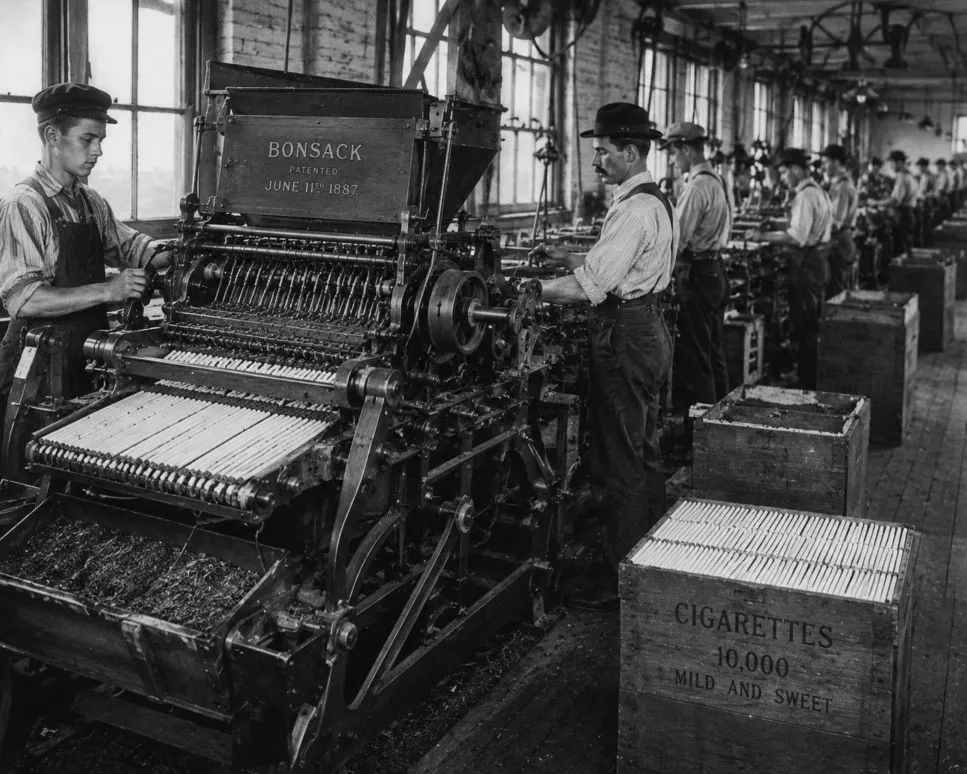
For most of the 19th century, cigarettes were a minor curiosity in America — chewing tobacco, snuff, and cigars dominated consumption. Hand-rolling cigarettes was slow, skilled work; even an expert roller could only produce a handful per minute, which kept cigarettes a relatively expensive, niche product compared to other tobacco forms.
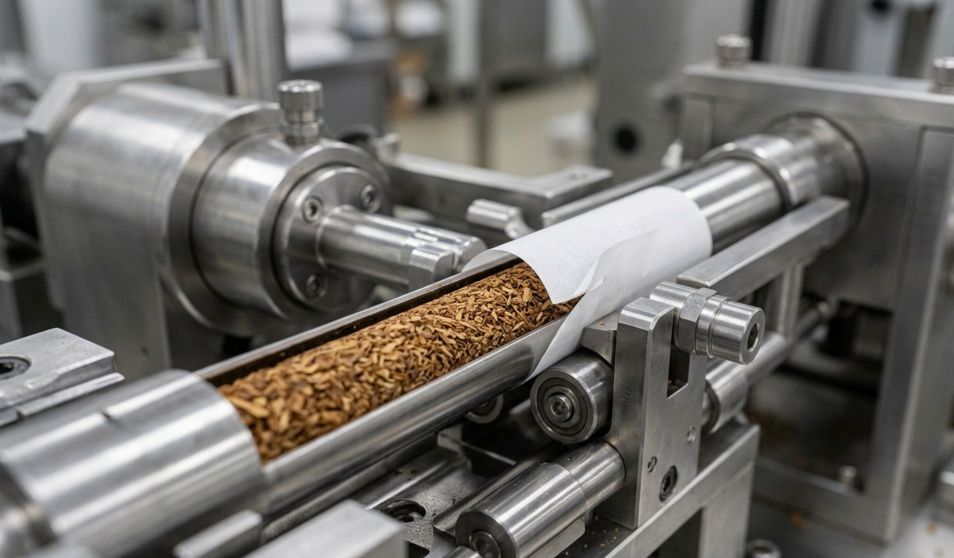
That changed because of a $75,000 prize (worth well over $2 million today) offered in 1875 by the Allen and Ginter tobacco company of Richmond, Virginia, for anyone who could invent a working cigarette-rolling machine. A young inventor named James Albert Bonsack took up the challenge, building and rebuilding prototypes after one was destroyed in a fire, and filed his patent application on September 4, 1880. He was granted U.S. patents in 1881 for what became known as the Bonsack machine — a device that fed tobacco onto a continuous paper strip and automatically formed, pasted, and cut it into finished cigarettes.
The numbers were staggering for the time: a single Bonsack machine could produce around 200 cigarettes per minute — roughly equivalent to what a skilled hand-roller could make in an hour, and at roughly half the cost.
Allen and Ginter, ironically, rejected the very machine they’d sponsored, worried consumers would reject “machine-made” cigarettes. The businessman who saw the opportunity instead was James Buchanan “Buck” Duke, who installed Bonsack machines in his Durham, North Carolina, factory starting in 1884. Duke negotiated an exclusive arrangement with the Bonsack Machine Company, reducing his per-unit royalty in exchange for running cigarettes exclusively on Bonsack equipment — a competitive advantage that let him undercut rivals on price while they were still paying workers to hand-roll.
Duke didn’t stop at manufacturing efficiency. In 1890, he combined his company with four major rivals to form the American Tobacco Company, capitalized at $25 million. Backed by aggressive pricing, heavy advertising spending (around $800,000 in 1889 alone — an enormous sum at the time), and continued acquisitions, American Tobacco came to dominate the market almost completely. By 1910, the company controlled an estimated 86% of the domestic cigarette market, along with roughly 76% of pipe tobacco and 84% of chewing tobacco.
That level of dominance ran straight into the federal government’s growing appetite for trust-busting under the Sherman Antitrust Act of 1890. The Department of Justice filed suit against American Tobacco on July 19, 1907, and after years of litigation, the Supreme Court ruled on May 29, 1911 — the same day it ordered the breakup of Standard Oil — that American Tobacco had engaged in unreasonable restraint of trade. The dissolution decree that followed split the trust into more than a dozen successor companies, the most significant of which were:
| Successor Company | Notable Legacy Brand |
| American Tobacco Company (reconstituted) | Lucky Strike (launched 1916) |
| Liggett & Myers Tobacco Company | Chesterfield |
| P. Lorillard Company | Old Gold |
| R.J. Reynolds Tobacco Company | Camel (launched 1913) |
Ironically, breaking up the monopoly didn’t end concentrated market power in the cigarette industry — it just redistributed it among four or five large competitors who would dominate American cigarette manufacturing for most of the 20th century.
The first half of the 20th century is when cigarettes went from a manufactured product to a cultural fixture. Two world wars played an outsized role. During World War I, cigarettes were distributed as part of standard soldier rations, normalizing the habit for millions of young men. General John J. Pershing reportedly told the War Department that tobacco was as essential to soldiers’ morale as food itself, and the U.S. government, along with the YMCA and Red Cross, shipped enormous quantities of cigarettes to troops in Europe.
The interwar years brought modern mass-market advertising into the picture. One of the most notorious campaigns came in 1929, when publicist Edward Bernays orchestrated the “Torches of Freedom” demonstration for Lucky Strike, recruiting young women to publicly smoke cigarettes during New York’s Easter parade as an act of feminist defiance — deliberately blurring the line between social progress messaging and brand marketing to expand the customer base to women.
When World War II arrived, the pattern repeated and intensified. American Tobacco’s wartime slogan — “Lucky Strike Green Has Gone to War” — turned a packaging change (driven by a shortage of the chromium green ink) into a patriotic marketing moment, while cigarettes were again included in military rations. By the middle of the century, smoking had become deeply embedded in American daily life — in offices, in films, on television, and in doctors’ own waiting rooms, where cigarette brands sometimes ran ads claiming physician endorsement.
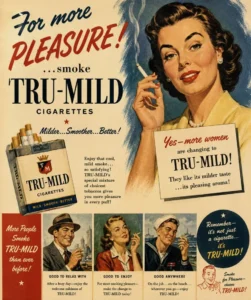
Scientific doubts had actually existed for decades — but they gained real traction starting in 1950, when a study published in the British Medical Journal linked smoking to lung cancer and heart disease. In 1957, U.S. Surgeon General Leroy Burney made it the official position of the Public Health Service that the evidence pointed to a causal relationship between smoking and lung cancer.
The watershed moment came on January 11, 1964, when Surgeon General Luther Terry released the first Surgeon General’s Report on Smoking and Health. Drawing on more than 7,000 existing biomedical articles, the report concluded that cigarette smoking was a definitive cause of lung and laryngeal cancer in men, a probable cause of lung cancer in women, and the most important cause of chronic bronchitis. It stopped short of calling nicotine “addictive” — the report’s own committee debated that word choice — but it unambiguously declared smoking “a health hazard of sufficient importance… to warrant appropriate remedial action.”
Public opinion shifted with remarkable speed: a 1958 Gallup survey found only 44% of Americans believed smoking caused cancer; by 1968, that figure had jumped to 78%.
Congress moved fast after the 1964 report, though full restrictions took several more years to land:
By the late 1990s, individual states had begun suing tobacco companies directly to recover Medicaid costs tied to treating smoking-related illness. Mississippi settled first in 1997, followed by Florida, Texas, and Minnesota, recovering a combined total of more than $35–40 billion. Then, on November 23, 1998, the attorneys general of the remaining 46 states, the District of Columbia, and five U.S. territories signed the Tobacco Master Settlement Agreement (MSA) with the four largest manufacturers — Philip Morris, R.J. Reynolds, Brown & Williamson, and Lorillard.
The numbers and terms were enormous by any standard:
It remains one of the largest civil settlements in U.S. legal history, and it fundamentally reshaped how — and how aggressively — tobacco could be marketed in America.
For decades, the FDA had argued it lacked clear legal authority to regulate tobacco as it did food and drugs — a position the Supreme Court confirmed in 2000. Congress closed that gap on June 22, 2009, when President Obama signed the Family Smoking Prevention and Tobacco Control Act into law. For the first time, the FDA had direct authority to regulate the manufacture, marketing, and sale of tobacco products nationwide.
Key provisions included:
In 2016, the FDA extended its authority further through a “deeming rule” that brought e-cigarettes, cigars, hookah tobacco, and pipe tobacco under the same regulatory umbrella — setting the stage for the vaping-era battles that followed.
E-cigarettes entered the U.S. market in the mid-2000s, initially marketed as a “safer” alternative for adult smokers trying to quit. By the mid-2010s, though, youth vaping had exploded — CDC data showed high-school e-cigarette use jumped roughly 78% (from 11.7% to 20.8%) between earlier surveys and 2018 alone, driven heavily by products like Juul.
In response, lawmakers moved on a policy that had started at the local level years earlier: raising the legal purchase age for tobacco. Hawaii passed the first statewide Tobacco 21 law in 2016, and on December 20, 2019, Congress made it federal law, raising the national minimum age to purchase any tobacco or nicotine product from 18 to 21.
The longer-term trend line tells its own story. In the mid-1960s, around 42% of American adults smoked cigarettes; by the early 2020s, that figure had fallen to roughly 11%, even as overall U.S. population — and overall tobacco product usage, once vaping is counted — shifted shape rather than disappearing. Today’s industry looks almost nothing like Duke’s 1890 trust: it’s smaller in raw cigarette volume, far more regulated, increasingly diversified into reduced-risk and alternative nicotine products, and dependent on highly automated, precision-engineered manufacturing lines rather than hand labor or even 1980s-era mechanical equipment.
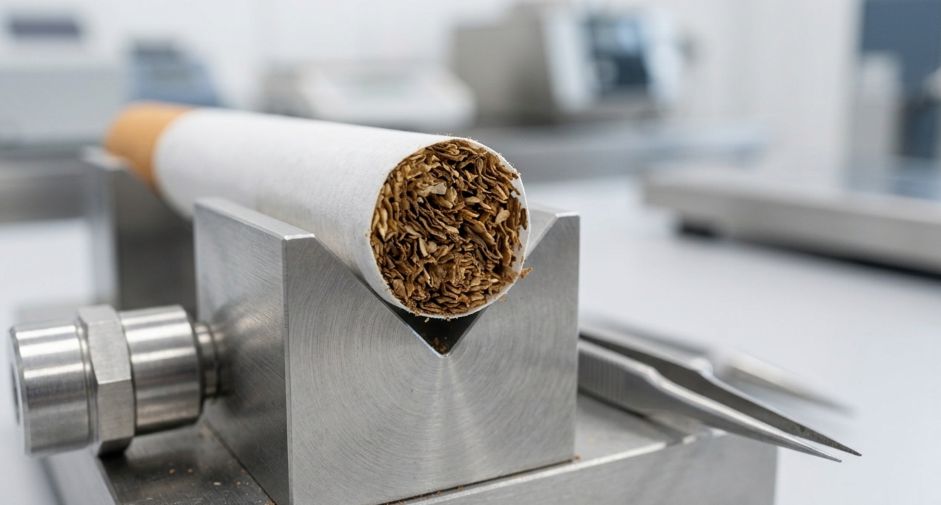
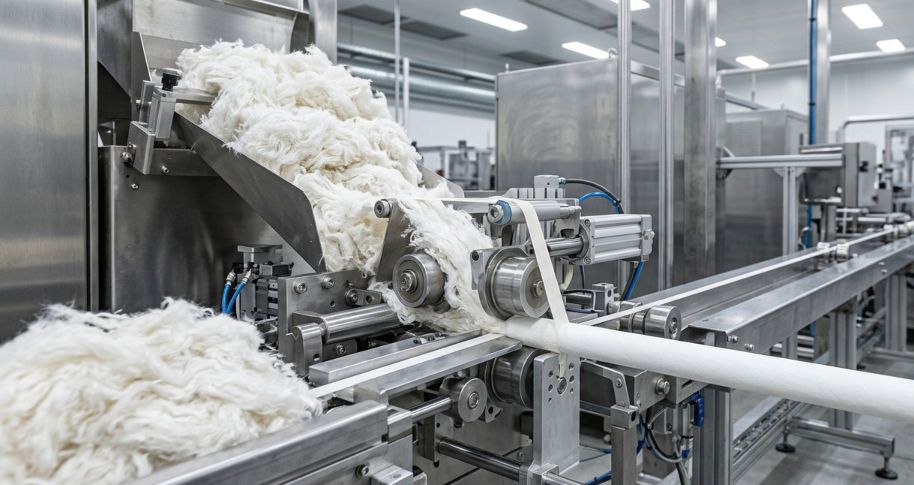
What’s remained constant through every regulatory shift, settlement, and consumption trend is the basic mechanical reality of cigarette production: raw tobacco still has to be processed, blended, rolled into rod form, fitted with filters, and packed at high speed with consistent quality — just with far more automation, precision, and compliance documentation than Bonsack or Duke ever had to think about.
For more than 30 years, Orchid Tobacco has supplied cigarette manufacturers in the United States and worldwide with the machinery and OEM-grade components that keep modern production lines running — from high-speed cigarette making machines capable of the precision and output today’s market demands, to cigarette packing machines built for the speed and consistency modern retail and regulatory standards require. Backed by a deep inventory of genuine and compatible spare parts, Orchid Tobacco has built its reputation as a trusted long-term partner for manufacturers who need reliable equipment, fast parts sourcing, and real industry expertise — not just a vendor relationship.
In an industry whose history has been defined by waves of mechanical innovation — from a $75,000 prize for a working rolling machine in 1875 to today’s fully automated, sensor-driven production lines — having the right machinery partner is still one of the most decisive factors in a manufacturer’s success.
Tobacco’s American story is really several stories layered on top of one another: an agricultural story that saved a failing colony, a labor and economic story tangled up with slavery and revolutionary-era debt, an industrial story about one inventor’s machine and one industrialist’s monopoly, a public health story that took the country decades to fully confront, and a regulatory story that’s still being written today through vaping rules, flavor bans, and FDA oversight.
What hasn’t changed across four centuries is the basic economic engine underneath it all: tobacco has always rewarded whoever could grow it, process it, and manufacture it most efficiently — from John Rolfe’s Orinoco seeds in 1612 to the automated production lines running in American factories today. Understanding that history isn’t just academic. It’s the context every manufacturer, supplier, and industry professional is still operating inside, whether they realize it or not.