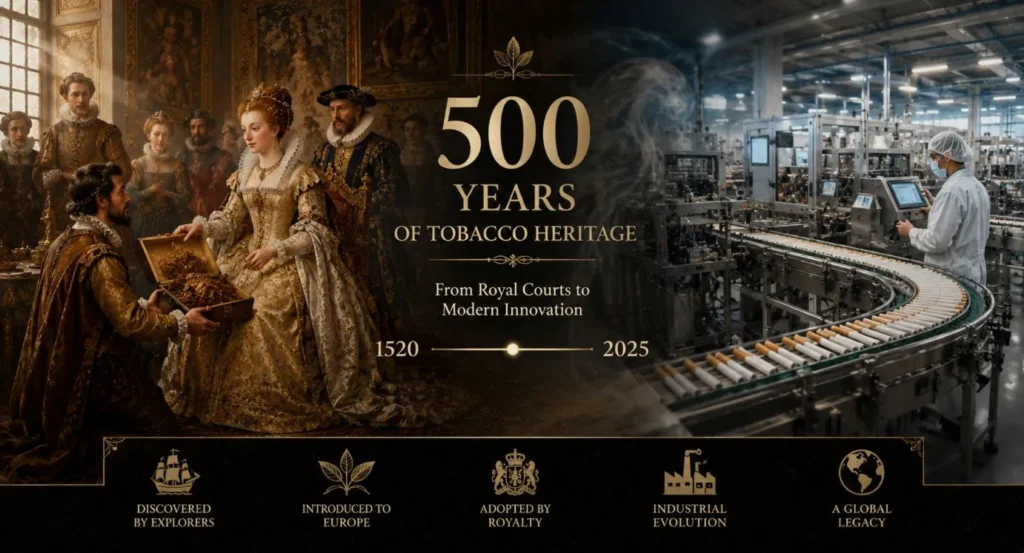
Tobacco crossed the Atlantic before it ever crossed a border checkpoint, a customs form, or a regulatory directive. What started as a curiosity carried home by Spanish sailors became a royal medicine, then a royal monopoly, then an industrial commodity fought over by British and American conglomerates, and finally one of the most tightly regulated consumer products in the European Union.
This is the complete story of that journey — from the Lisbon prison garden where a French diplomat first encountered the plant, through the state-run factories of Seville and Bristol, to the EU directives and WHO treaties that define how tobacco is made and sold across the continent today.
Along the way, you’ll find the real dates, the real figures, and the real political deals — from a 1560 gift to a French queen’s migraine to a 2014 European directive covering 28 member states — that mark tobacco’s five-century run through European history.
| Era | Key Date | Major Event |
|---|---|---|
| Arrival | 1492 – 1560 | Tobacco reaches Europe via Spain and Portugal; introduced to the French court |
| Royal Courts | 1586 – 1604 | Tobacco popularized in England; King James I publishes his famous attack on smoking |
| State Monopolies | 1636 | Spain establishes the world’s first official tobacco monopoly |
| Industrial Age | 1728 – 1770 | The Royal Tobacco Factory of Seville becomes Europe’s largest industrial building |
| Cigarette Era Begins | 1847 – 1856 | Philip Morris opens in London; the Crimean War popularizes the cigarette |
| Corporate Consolidation | 1901 – 1902 | Imperial Tobacco forms in Britain; British American Tobacco is created |
| World Wars | 1914 – 1945 | Cigarette rationing and trench-warfare smoking culture sweep the continent |
| Health Reckoning | 1962 | The Royal College of Physicians publishes Britain’s landmark smoking report |
| Global Treaty | 2003 – 2005 | The WHO Framework Convention on Tobacco Control is adopted and ratified |
| Smoke-Free Pioneer | 2004 | Ireland becomes the first country in the world with a full workplace smoking ban |
| Modern EU Standard | 2014 | The EU’s revised Tobacco Products Directive (TPD2) takes effect |
| Today | 2016 – present | Vaping regulation, heated tobacco, and a third Tobacco Products Directive in development |
Tobacco’s European story begins, fittingly, with Columbus. In 1492, his crew encountered Indigenous peoples in the Caribbean using a burning, rolled leaf they called “tabaco.” One of his sailors, Rodrigo de Jerez, is often credited as the first European to smoke — and was reportedly investigated by the Spanish Inquisition for it, since the sight of smoke pouring from a man’s mouth alarmed his neighbors back home.
Spain held the first real grip on the plant. Seville, home to the Crown’s Casa de Contratación (House of Trade), controlled all legal commerce with the Americas, which meant nearly all tobacco entering Europe passed through Spanish hands first. Sailors and colonists had been smoking it casually for decades before it became fashionable elsewhere on the continent.
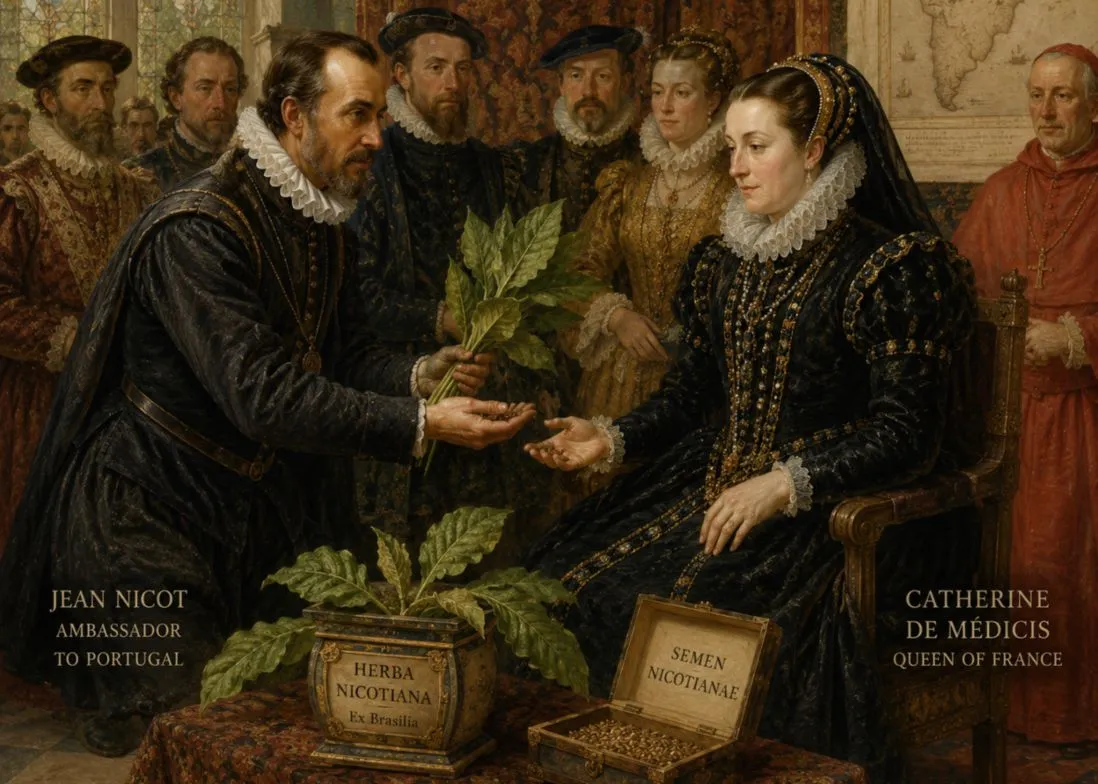
The turning point for tobacco’s reputation came through medicine, not recreation. In 1559, French diplomat Jean Nicot arrived in Lisbon as ambassador to Portugal. He learned of tobacco’s supposed healing properties from a local scholar and tested a tobacco ointment on a man with a tumor — convincing himself the plant was a genuine medical marvel. In 1560, Nicot sent tobacco seeds and powdered leaf to Catherine de Médicis, Queen of France, recommending it as a cure for her son’s migraines. It worked well enough that the French court began calling tobacco “herbe à la Reine” — the queen’s herb. By 1570, European botanists were referring to the plant as Nicotiana, and the chemical compound inside it would later carry his name too: nicotine.
England’s relationship with tobacco started a little later and a lot more contentiously. Sailors like Sir John Hawkins may have brought tobacco to English shores as early as the 1560s, but it was Sir Walter Raleigh who’s traditionally credited with popularizing pipe smoking at court after returning from Virginia in 1586. Legend has it Raleigh even convinced Queen Elizabeth I to try a pipe around 1600.
Her successor was considerably less enthusiastic. King James I loathed the habit so intensely that in 1604 — just a year into his English reign — he anonymously published A Counterblaste to Tobacco, describing smoking as a “custome lothsome to the eye, hatefull to the Nose, harmefull to the braine, [and] dangerous to the lungs.” Part of his objection was genuinely about health; part of it was personal dislike of Raleigh, whom he later had executed. James backed his words with policy, slapping an enormous import tax on tobacco — roughly 6 shillings 8 pence per pound, equivalent to a small fortune at the time. By 1624, with demand still climbing despite the tax, James gave up trying to suppress tobacco altogether and instead established a royal monopoly over the Virginia crop, choosing to profit from the habit rather than fight it.
Meanwhile, on the continent, several countries tried outright prohibition instead of taxation. France, Russia, Sweden, and Switzerland all experimented with smoking bans during the 1600s, and the Ottoman Sultan Murad IV went furthest of all — banning tobacco in 1633 and reportedly having smokers executed for defying it. None of these bans held for long; tobacco’s popularity simply outran the willingness of governments to enforce prohibition.
While England argued over taxation, Spain quietly built the template every other European tobacco monopoly would later copy. Seville’s position as the gateway for all American trade meant it became Europe’s first real center of tobacco processing, with small manufacturing operations clustered near the city from the early 1600s onward.
In 1636, Spain formalized this dominance by creating the “Real Estanco del Tabaco” — the world’s first state-run tobacco monopoly. Rather than letting private merchants sell tobacco freely, the Spanish Crown claimed exclusive rights to the trade, a model that would generate steady royal revenue for centuries and that other European powers would eventually imitate. This single decision effectively invented the idea of tobacco as a government revenue instrument — a concept that, in various forms, still shapes tobacco taxation and regulation across Europe today.
By the 18th century, snuff — finely ground tobacco inhaled through the nose — had overtaken pipe smoking as the fashionable habit among European nobility, a trend traceable directly back to Catherine de Médicis’s migraine cure two centuries earlier. Ornate snuff boxes became status symbols across French and English high society.
Spain’s response to growing demand was architectural as much as administrative. Construction began in 1728 on the Royal Tobacco Factory in Seville, a vast stone complex that took more than 40 years to complete. By the time production started in earnest in 1758, the factory employed roughly 1,000 men and 200 horses, running 170 grinding mills to produce snuff from tobacco shipped in from Virginia and Spain’s American colonies. When finished in 1770, it covered 185 by 147 meters — at the time, the second-largest building in all of Spain, behind only the royal monastery-palace of El Escorial, and one of the largest industrial buildings anywhere in Europe.
Other continental powers followed Spain’s lead through the 1700s, establishing their own state tobacco monopolies as a reliable source of crown revenue — a pattern that would persist, in various forms, in countries including France, Austria, and Portugal well into the 20th century.

France’s relationship with state-controlled tobacco deepened through the Napoleonic era, when the Empire leaned on tobacco taxation and monopoly control as a dependable way to fund its near-constant wars. That state-monopoly tradition stuck: France’s tobacco administration would eventually become SEITA (Société d’exploitation industrielle des tabacs et allumettes), a government-run entity that controlled French tobacco manufacturing for most of the 20th century before privatizing and eventually merging with Spain’s own former monopoly, Tabacalera, to form Altadis in 1999.
It’s a small but telling detail of European tobacco history: the two earliest and most rigid state tobacco monopolies on the continent, Spain’s and France’s, ended up merging into the same company nearly four centuries after Spain first invented the model.
For most of European history, tobacco meant pipes, cigars, or snuff — the cigarette as we know it barely existed. That changed thanks, oddly enough, to a war.
During the Crimean War (1853–1856), British and French soldiers fighting alongside Ottoman Turkish troops were introduced to a habit common among their allies: rolling tobacco in thin paper rather than smoking it in a pipe. Soldiers returning home brought the habit — and a taste for Turkish-style tobacco — back with them, and within a few years cigarette smoking had shifted from a niche, lower-class habit to something genuinely fashionable in London and Paris.
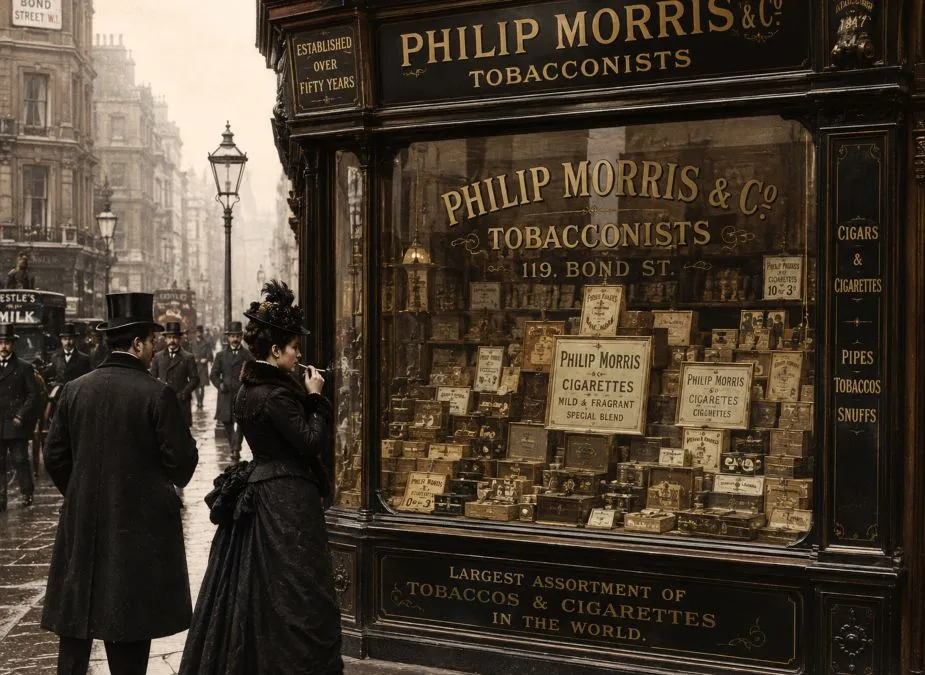
A young London tobacconist named Philip Morris had opened a small shop on Bond Street in 1847, initially selling cigars and pipe tobacco to an upscale clientele. By the mid-1850s, noticing returning Crimean veterans favoring Turkish-style cigarettes, Morris began hand-rolling and selling cigarettes himself — eventually building a business that, decades later and under different ownership, would become Philip Morris International, today one of the largest cigarette companies on earth. The brand even earned royal favor: in 1902, King Edward VII, a longtime customer, appointed the firm as official royal tobacconist.
Hand-rolling cigarettes, even fashionable Turkish-style ones, was slow and expensive. That changed when American inventor James Bonsack patented his automatic cigarette-rolling machine in the United States in 1880 — a device capable of producing roughly 200 cigarettes per minute. The Bonsack machine was imported to England in 1883, and within a few years European manufacturers were racing to mechanize alongside their American counterparts.
That race turned into outright corporate warfare by the turn of the century. American industrialist James Buchanan Duke, who’d built a near-monopoly over U.S. cigarette production through his American Tobacco Company, set his sights on the British market in 1901, buying the British firm Ogden’s Limited as a beachhead. Thirteen alarmed British tobacco manufacturers — including the major players W.D. & H.O. Wills and John Player & Sons — responded by banding together to form the Imperial Tobacco Company in December 1901, specifically to fend off Duke’s expansion.
The standoff didn’t last long. After a brief, expensive price war, the two sides struck a deal in September 1902: Duke’s American Tobacco would exit the British market entirely, Imperial would abandon plans to expand into the U.S., and the two companies would jointly create a new entity — the British American Tobacco Company (BAT) — to handle every market outside Britain and the United States. BAT was capitalized two-thirds by the American side and one-third by Imperial, with Duke himself serving as its first chairman. When the U.S. Supreme Court broke up Duke’s American Tobacco trust in 1911 on antitrust grounds, American Tobacco was forced to sell its BAT shares, leaving the company independently listed in London — and still, more than a century later, one of the largest tobacco companies in the world.
| Company | Formed | Origin |
|---|---|---|
| Imperial Tobacco Company | 1901 | Merger of 13 British manufacturers to counter American Tobacco’s UK expansion |
| British American Tobacco (BAT) | 1902 | Joint venture between Imperial Tobacco and American Tobacco to divide world markets |
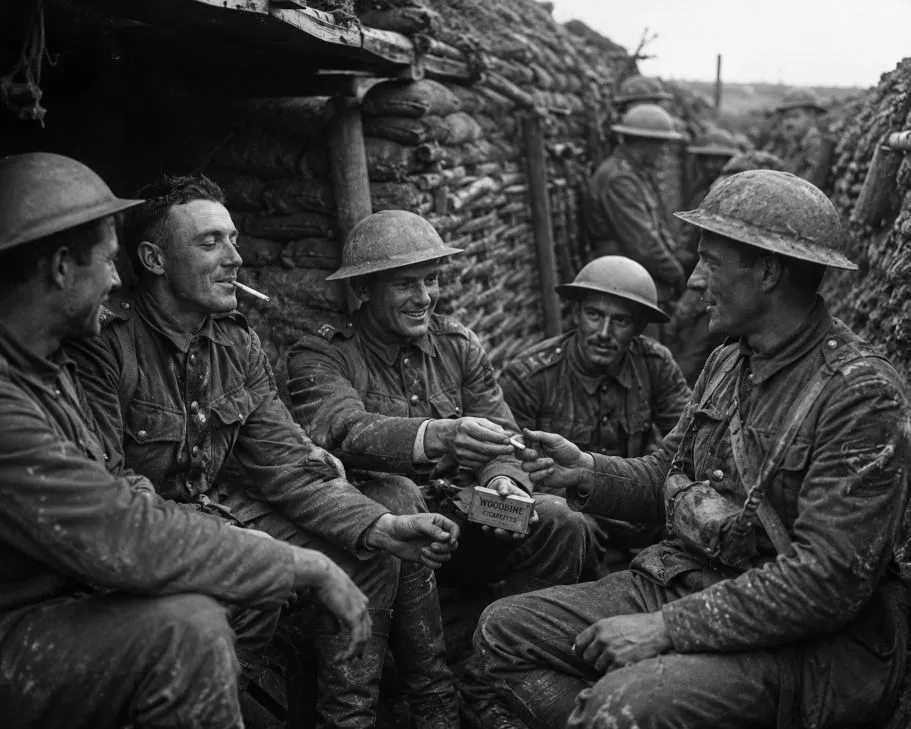
World War I cemented the cigarette’s place in European daily life. Cigarette brands like Woodbine became known across the British Army simply as “the soldier’s smoke,” issued as part of standard rations and smoked heavily in the trenches as a rare comfort amid the misery of static warfare. Tobacco consumption across combatant nations rose sharply during the war and never fully retreated afterward.
World War II repeated the pattern on an even larger scale. Cigarettes were again distributed as part of military rations across Allied and Axis forces alike, and wartime advertising on both sides of the Atlantic leaned hard on patriotic and morale-boosting messaging. By the time peace returned in 1945, smoking had become deeply normalized across nearly every layer of European society — in offices, cafés, trains, and homes alike.
Scientific doubt about tobacco’s safety had been building quietly for years, but Britain delivered Europe’s first major institutional wake-up call. In 1962, the Royal College of Physicians published a landmark report definitively linking smoking to lung cancer and other serious diseases — predating the more widely known 1964 U.S. Surgeon General’s Report by two years and setting off similar reassessments across the continent.
The European response, though, was far slower and far more fragmented than what followed in the United States. Without a unified European regulatory body, each country was left to set its own pace on warning labels, advertising restrictions, and taxation — a patchwork that would persist for decades.
Through the 1970s, 80s, and 90s, European tobacco control moved in scattered, national increments rather than coordinated continental policy. A genuine turning point came in 1985, when the European Economic Community launched its “Europe Against Cancer” program — the first real EU-level push connecting cancer prevention policy to tobacco control specifically, and the seed from which later EU tobacco legislation would grow.
That groundwork eventually produced the 2001 Tobacco Products Directive (2001/37/EC) — the EU’s first unified set of rules governing how tobacco products could be manufactured, labeled, and sold across all member states. It was a modest document by today’s standards, but it represented the first time Brussels, rather than individual national governments, set baseline tobacco rules for the entire bloc.
The most significant regulatory shift of the early 2000s wasn’t actually European in origin — it was global. On May 21, 2003, the World Health Assembly in Geneva adopted the WHO Framework Convention on Tobacco Control (FCTC), the first-ever international public health treaty negotiated under the World Health Organization. It called on signatory nations to adopt clean indoor air laws, advertising restrictions, taxation measures, and standardized warning labels.
The treaty entered into force on February 27, 2005, after being ratified by enough countries to trigger it, and the European Union itself became a signatory — meaning EU member states were now operating under both their own national laws and a binding international tobacco-control framework simultaneously. It remains one of the most rapidly and widely ratified treaties in United Nations history.
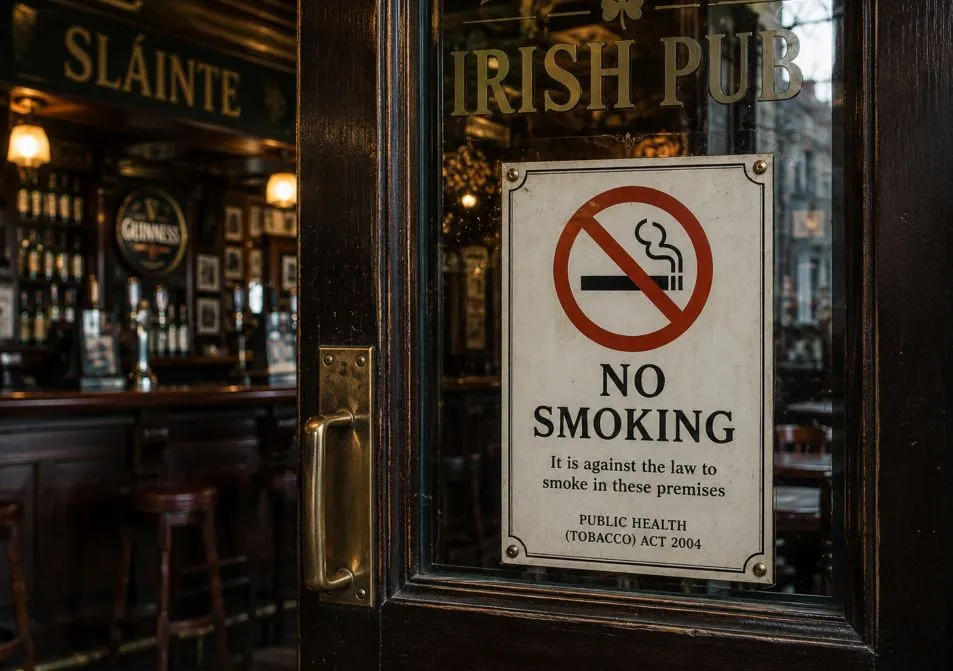
If there’s a single moment that symbolizes Europe’s shift from tolerating smoking to actively restricting it, it’s March 29, 2004 — the day Ireland became the first country anywhere in the world to ban smoking in all enclosed workplaces, including pubs and restaurants. For a country with a deeply embedded pub culture, the move was genuinely radical, and predictions of public backlash and business collapse were widespread before it took effect.
None of those predictions held up. Within a month, government inspectors found roughly 97% compliance nationwide, public approval polling came in overwhelmingly positive, and cigarette sales dropped by an estimated 16% in the first six months alone — the largest short-term decline ever recorded in the country. Ireland’s success triggered a rapid domino effect across Europe: Norway followed within months, Italy banned workplace smoking in January 2005, Scotland went smoke-free in 2006, France banned smoking in public places in January 2008, and England followed in July 2007. What started as one small island nation’s bold experiment became the template for smoke-free policy across the entire continent.
The 2001 Tobacco Products Directive had aged badly by the 2010s — it had nothing to say about e-cigarettes, which didn’t exist yet when it was written, and its warning label requirements were comparatively weak. The European Commission began a formal review in 2009, a process that took over five years and faced intense lobbying resistance from the tobacco industry before the revised Tobacco Products Directive (2014/40/EU) — commonly called TPD2 — was finally adopted on April 3, 2014, and entered into force on May 20, 2016.
The new rules were dramatically tougher than what came before:
It remains the regulatory backbone of tobacco control across the European Union today.
The product landscape kept shifting even as TPD2 was being implemented. Heated tobacco products like Philip Morris International’s IQOS system expanded rapidly across European markets through the late 2010s, occupying a regulatory middle ground between traditional cigarettes and e-cigarettes that lawmakers are still working through. Vaping products, meanwhile, have continued growing in popularity among younger Europeans, prompting renewed concern from public health bodies about a new generation developing nicotine dependence through products that didn’t exist when most tobacco control law was written.
The European Commission has been working on a third revision — TPD3 — expected to tighten rules further around flavored nicotine pouches, heated tobacco labeling, environmental packaging requirements, and track-and-trace systems aimed at curbing the illicit cigarette trade, which is estimated to account for roughly 10% of cigarettes consumed in the EU. Given the EU’s legislative timelines, industry observers don’t expect TPD3 to take full effect much before 2028.
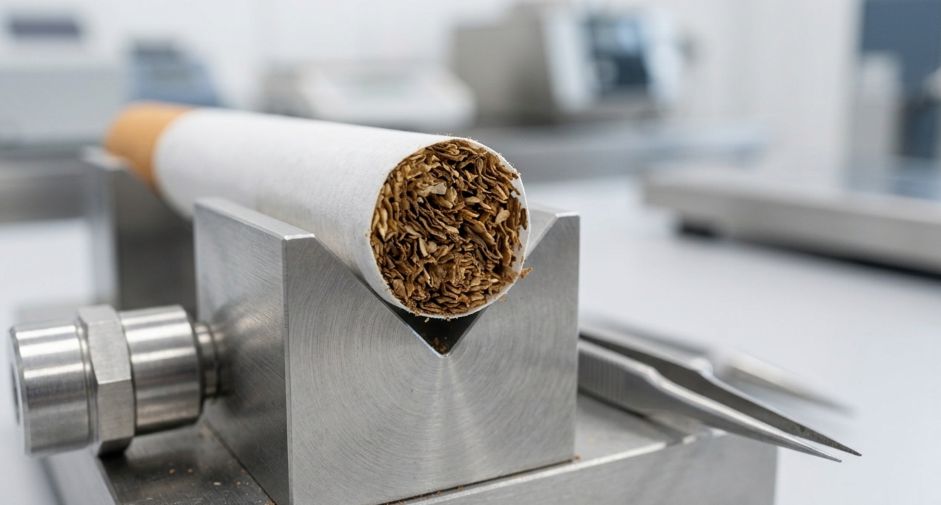
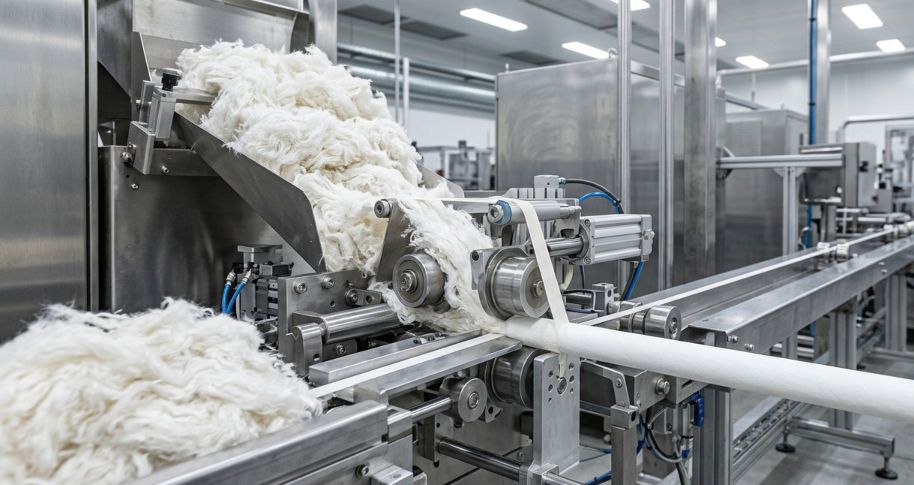
What’s remained constant through five centuries of royal monopolies, corporate wars, and EU directives is the underlying mechanical challenge: raw tobacco still has to be processed, blended, formed into rod, fitted with filters, and packed to exacting, increasingly regulated specifications — and doing that reliably at scale requires serious, well-maintained machinery.
For more than 30 years, Orchid Tobacco has supplied cigarette manufacturers across Europe and worldwide with the equipment and components that keep modern, compliant production lines running — from precision cigarette making machines built to handle today’s tighter manufacturing tolerances, to cigarette packing machines engineered for the large graphic warning labels and pack-size rules introduced under TPD2. Backed by a deep inventory of genuine and compatible spare parts, Orchid Tobacco has built a long-standing reputation as a dependable partner for manufacturers who need reliable equipment, fast parts sourcing, and real industry expertise — not just a vendor relationship.
In a regulatory environment that keeps evolving — from Spain’s 1636 monopoly to today’s EU directives — having machinery flexible and well-supported enough to keep pace with new compliance requirements is still one of the most decisive factors in a manufacturer’s long-term success.
Tobacco’s European story is really a story about control — who gets to grow it, profit from it, regulate it, and ultimately restrict it. From a French queen’s migraine remedy to a Spanish royal monopoly, from a British king’s furious pamphlet to an EU directive running hundreds of pages, every era of European tobacco history has been defined by some authority trying to manage a plant that consistently outran their ability to fully contain it.
What’s changed across five centuries isn’t the underlying tension — it’s who’s doing the regulating and how sophisticated the tools have become, on both sides. Manufacturers today operate inside a far more codified, transparent regulatory framework than Duke or Bonsack ever faced, but the basic commercial reality is the same one that built the Royal Tobacco Factory of Seville: efficient, well-run production still wins.