Pressure drop and draw resistance get used almost interchangeably on a factory floor, and in casual conversation that’s harmless enough. But they’re not measuring exactly the same thing, and the distinction matters most at the filter manufacturing stage, well before a filter ever gets combined with a tobacco rod. Cigarette pressure drop is a specific, isolated measurement, and understanding it properly is central to how filter quality gets controlled before a finished cigarette is even assembled.
This article covers what pressure drop actually means, how it’s tested, and why filter manufacturers treat it as one of the most tightly controlled specifications in the entire production process.
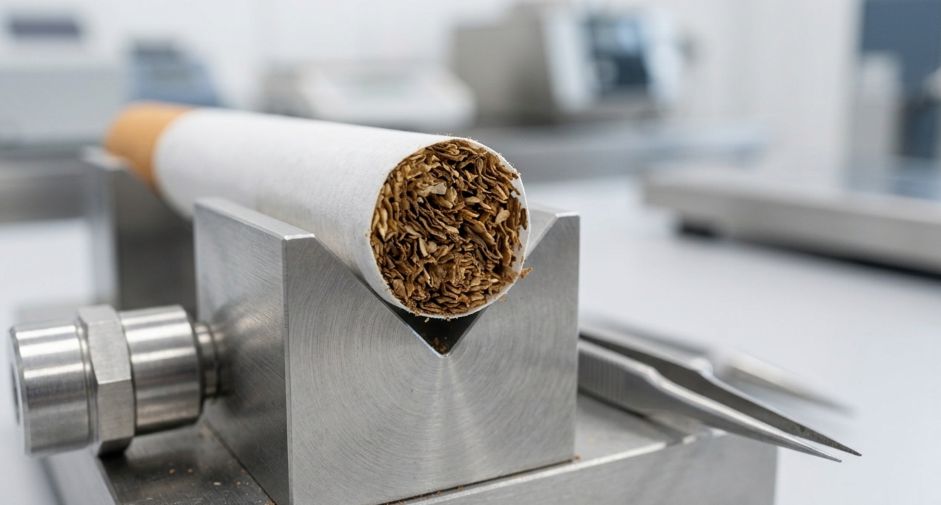
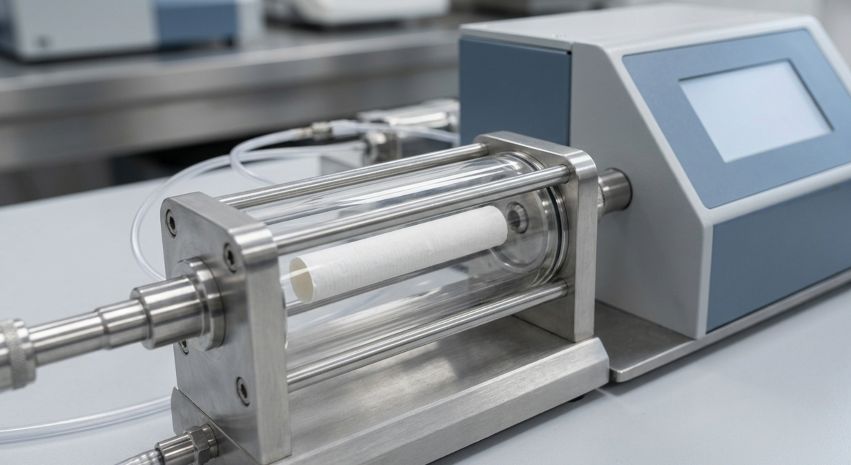
Pressure drop is the resistance to airflow through a specific component, tested in isolation, most commonly a filter rod, before it’s combined with anything else. It’s measured under the same principle as draw resistance, air is drawn through the sample at a fixed, standardized flow rate, and the resulting pressure difference across the sample is recorded, typically in millimeters of water gauge (mmWG) or pascals (Pa).
These terms describe the same underlying physical measurement, airflow resistance, applied at different points in production. Pressure drop refers to a single component tested on its own, most often a filter rod straight off the filter rod maker, but the term also applies to cigarette paper or plug wrap tested independently. Draw resistance refers to the finished, fully assembled cigarette, tobacco rod, filter, and all wrapping papers together. Our guide to cigarette draw resistance testing covers that finished-product measurement in full detail. In practice, a filter’s pressure drop is one of the largest single contributors to a finished cigarette’s total draw resistance, which is exactly why manufacturers test it separately and early rather than waiting to catch a problem only after a cigarette is fully built.
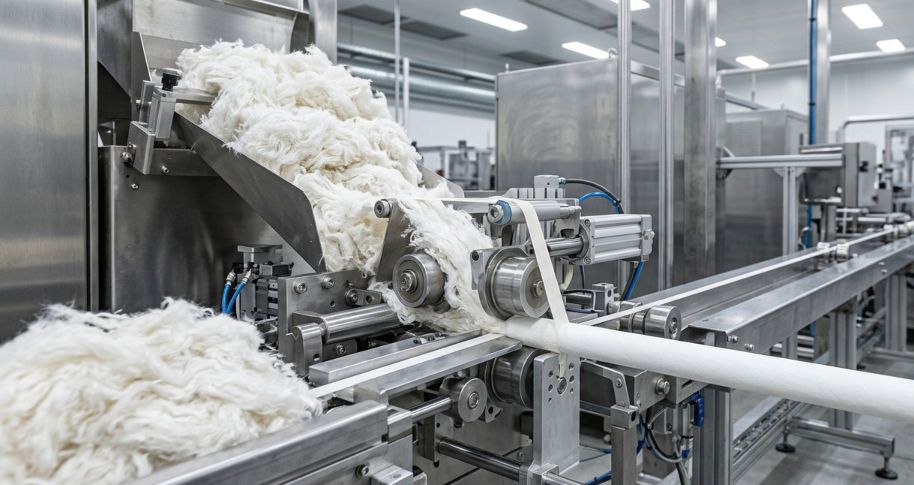
The primary application is filter rod testing, carried out at the filter manufacturing stage covered in our guide to cigarette filter rod manufacturing. Pressure drop testing there confirms a filter rod meets its target specification before it’s ever cut down and combined with a tobacco rod. The same underlying test also applies to cigarette paper and plug wrap as standalone materials, since both contribute their own airflow resistance characteristics that feed into a finished cigarette’s overall draw resistance, discussed further in our guide to cigarette paper types.
Testing uses a dedicated instrument that draws air through the sample at a fixed, standardized flow rate, typically around 17.5 cm³ per second, matching the flow rate used in standard cigarette smoking machine testing. The pressure difference generated across the sample is recorded as its pressure drop reading. This methodology is governed by ISO 6565, the international standard covering standard conditions testing for pressure drop and draw resistance, alongside equivalent CORESTA Recommended Methods used across the industry to keep results comparable between labs, suppliers, and manufacturers.
Testing pressure drop at the filter rod stage, rather than only checking draw resistance after a finished cigarette is assembled, lets manufacturers catch a problem while it’s still cheap to fix. A filter rod that’s out of spec can be identified and rejected before it consumes tobacco, paper, and production time being built into a finished cigarette that would then also fail its own downstream testing. This is a straightforward cost and efficiency argument as much as a quality one, since catching a defect early in a production chain is almost always less expensive than catching it at the very end.
Filter rod pressure drop varies considerably by filter type, length, and density, and there’s no single industry-standard target. Standard cellulose acetate filters commonly fall somewhere in a broad range depending on the specific product’s design intent, with denser or longer filters generally producing higher readings than shorter or lighter ones. Every filter design carries its own specified target range and tolerance, set during product development based on the finished cigarette’s intended draw characteristics.
Several variables in the filter rod making process directly affect pressure drop readings. Tow density and how evenly the fiber was bloomed before forming both influence how freely air moves through the finished rod. Plasticizer application affects fiber bonding density, which in turn affects airflow resistance. Rod diameter and overall filter length also scale pressure drop proportionally, since a longer or denser rod inherently resists airflow more than a shorter or looser one. Our guide to cigarette filter rod manufacturing covers how each of these variables is controlled during production.
A finished cigarette’s total draw resistance is effectively the combined result of filter pressure drop, tobacco rod resistance, and the airflow contribution of the papers involved, covered in our guide to the cigarette rod making process. Because filter pressure drop is known and controlled before assembly, manufacturers can predict, with reasonable accuracy, where a finished cigarette’s draw resistance will land, and adjust upstream specifications if a target isn’t being consistently hit.
Pressure drop testing is one piece of a much broader quality system running from raw leaf through finished pack, covered in full in our guide to cigarette manufacturing quality control. For brand owners working through private label or contract manufacturing arrangements, filter pressure drop specification ties directly to a brand’s target draw feel, and it’s a reasonable, specific question to ask a manufacturer when discussing filter type and product positioning.
Cigarette pressure drop is a precise, component-level measurement that exists to catch problems before they ever reach a finished, assembled cigarette. It’s closely related to draw resistance but distinct in what it actually tests and when in the production process it gets applied. Manufacturers who test pressure drop rigorously at the filter stage are, in effect, predicting and controlling finished product draw resistance well before that cigarette is fully built, which is a meaningfully more efficient way to run quality control than relying on finished-product testing alone.

We specialize in the provision of Tobacco Machinery. Our expertise encompasses not only the trading of machinery but also extends to being a dedicated supplier. This specialization is enriched by our comprehensive solutions tailored for emerging Cigarette Companies. What sets us apart is our ability to offer firsthand insights through our active Cigarette Manufacturing operation in the UAE.