Automation in the packaging industry has reduced labor costs, increased efficiency, cut waste, and improved production quality across food, beverage, pharmaceutical, and tobacco manufacturing alike. The global food packaging machinery market alone was valued at roughly $21.5 billion in 2025 and is projected to reach $28.5 billion by 2032, growing steadily as manufacturers replace manual lines with automated filling, sealing, wrapping, and labeling systems. Below is a full look at what packaging automation actually involves, the concrete benefits it brings to a production line, the types of machines available, and how a business can start adopting it.
Automation in packaging means using machinery to carry out the packaging process from start to finish with minimal human involvement. Packaging technology has progressed gradually toward this point: early automated equipment handled a single step in isolation, and modern lines now integrate those steps, filling, sealing, wrapping, labeling, and printing, into one continuous, coordinated process.
The result is lower labor cost, higher sustained output, and fewer workplace injuries tied to repetitive manual handling.
Yes, and the shift has accelerated noticeably over the past decade. Manufacturers have adopted automation primarily because the economics have become hard to ignore: a single automated machine can pick and place products, form pouches, and seal them in one continuous cycle, at a pace and consistency manual labor simply can’t sustain across a full shift. Combined with rising labor costs and growing competitive pressure to shorten turnaround times, automation has moved from a competitive advantage to close to a baseline expectation on most modern packaging lines.
Automation offers several concrete benefits that make it a genuinely valuable investment for packaging operations. From quality control to production speed, here’s what it actually delivers.
Quality control was traditionally handled by human inspectors, who are prone to fatigue-driven errors and inconsistency over a long shift. Automated systems catch flaws and defects with a level of accuracy and consistency that manual inspection can’t reliably match.
Automated systems perform packaging tasks faster and more consistently than manual labor, which directly raises total output.
Repetitive packaging tasks are a well-documented source of musculoskeletal injury. Automation removes much of that physical strain from the workforce.
Rising wages and tightening labor markets are a real cost pressure for packaging operations, and automation directly addresses that.
Human-machine interfaces (HMIs) are increasingly standard on packaging automation, giving operators and management direct visibility into line performance.
There’s a wide range of automated packaging equipment available depending on your specific requirements, sized for both large and small operations. Here’s a breakdown of the main categories:
Positioned at the end of a packaging line, accumulators sort and collect finished goods into a holding area, saving valuable floor space.
These fill pouches with air to create cushioning, reducing empty space inside a package and restricting product movement during transit.
Bags are opened with a controlled blow of air before products are inserted, speeding up bag filling operations considerably.
Purpose-built to seal and secure filled bags completely.
Place a set, consistent number of products into each bag automatically.
Apply lid caps to jugs, bottles, and jars after filling, capable of capping thousands of containers per hour.
Apply tape to boxes as they pass through the machine, sealing every open side properly and consistently.
Take flat-packed boxes and fold them into shape so products can be loaded in.
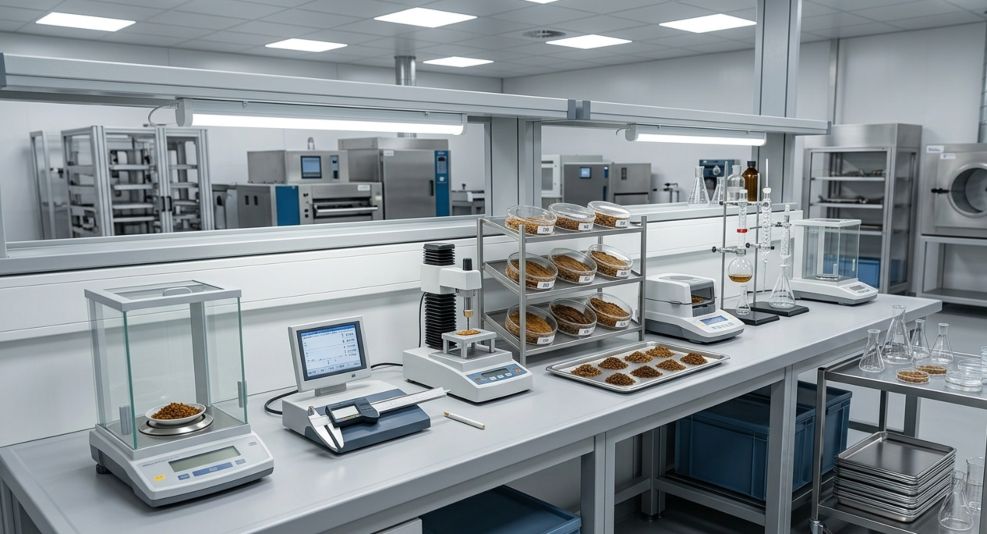
Confirm that product weight meets spec, rejecting anything that falls outside the acceptable range before it moves further down the line.
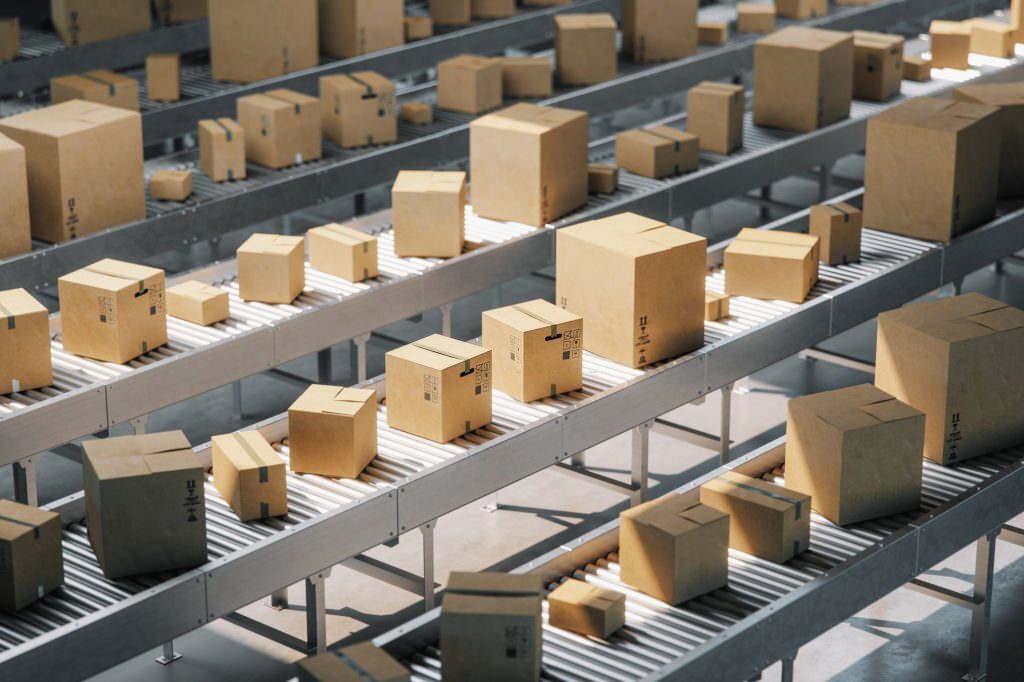
Move product between stages of a packaging line and are one of the most fundamental components of any fully automated setup.
Deliver a consistent, precisely measured amount of liquid into containers.
Wrap products with clean, tight edges that are easy to tear open, commonly used across food and consumer goods packaging.
Apply labels to products, containers, and packages, typically as one of the final steps on a packaging line.
Wrap products in a protective outer film to guard against external damage or contamination, capable of wrapping thousands of units per hour.
Weigh products during packing or at the point of freight and parcel shipping.
Bundle multiple items together, often using polypropylene strapping for added transit strength.
Remove air from packaging to extend shelf life, particularly valuable for perishable or moisture-sensitive products.
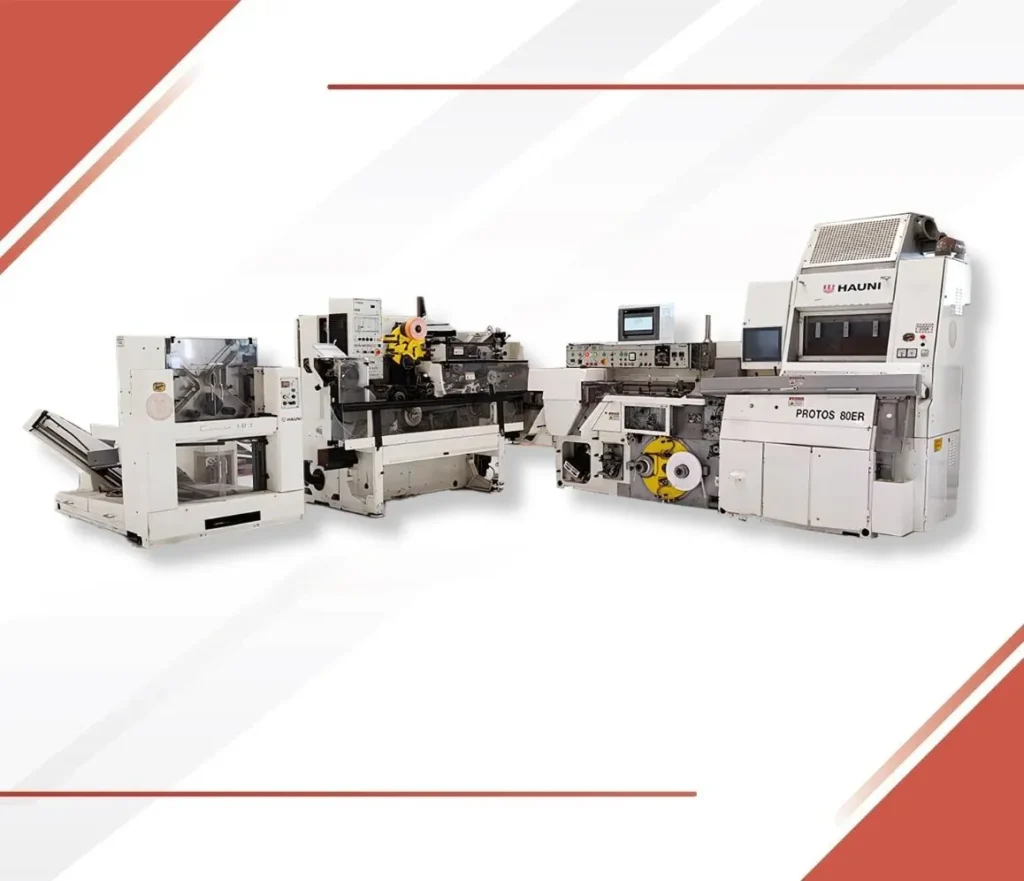
Most of the equipment categories above translate directly into cigarette and tobacco manufacturing, just under different names. A cigarette packing line runs its own version of carton sealers, case erectors, and overwrappers, purpose-built for cigarette packs and cartons rather than food or general consumer goods. High-speed lines like the HLP packing line combine several of these functions, filling, sealing, and cellophane overwrapping, into a single coordinated system, the same principle behind general packaging automation applied specifically to cigarette production.
The benefits carry over directly too: fewer manual handling injuries, consistent pack quality regardless of shift or operator fatigue, and lower long-term labor cost per thousand packs produced. For manufacturers weighing new equipment, Orchid Tobacco’s Cigarette Packing Machines and Cigarette Box Wrapping Machines apply exactly this kind of automation to tobacco-specific packaging requirements.
One difference worth knowing if you’re moving from general packaging equipment into tobacco specifically: cigarette packaging runs at a scale and precision that most general consumer goods lines aren’t built for. A high-speed cigarette packer can process hundreds of packs per minute, which means the folding plates, sealing jaws, and film feed systems have to hold tolerance at a speed where even a small mechanical variance shows up instantly as a visible defect. That’s part of why tobacco-specific packaging machinery tends to be purpose-engineered rather than adapted from general-purpose packaging lines.
Not every automation upgrade delivers the same return, and a few factors are worth weighing before committing to new equipment. Current production volume matters most: automation pays off fastest on lines already running near capacity, where labor cost and throughput limits are the actual bottleneck. Product variability matters too, a line packaging a single consistent product format sees faster payback than one constantly changing over between different pack sizes or formats, since changeover time eats into the efficiency gains automation is supposed to deliver. Finally, integration with existing equipment is worth checking carefully; a new automated station that isn’t properly synced to the machines feeding it or receiving from it downstream can end up creating a bottleneck rather than removing one, which is exactly the line-balancing problem that shows up across cigarette manufacturing as much as it does in food and general packaging.
Packaging is critical to how a product survives transport and reaches the customer in good condition, regardless of industry. Here are practical, proven ways to bring automation into a packaging operation.
Robotic packaging systems handle a wide range of products, reduce errors, increase efficiency, and manage labeling in one integrated system. The level of automation is configurable to the specific operation, and the impact on labor and operating costs is usually noticeable almost immediately after installation.
Motion control is especially valuable for packaging pharmaceuticals, food, and beverages where palletizing, stacking boxes or cases onto pallets for transport, is difficult to do consistently by hand. Motion control keeps palletizing coordinated and stable regardless of product size, reducing the risk of stacks shifting or collapsing in transit.
Semi-automated pallet wrappers reduce material waste by improving the consistency and precision of film pre-stretching, getting more coverage out of less material with virtually no waste.
Form fill and seal machines handle filling, sealing, and forming in a single pass, improving packaging durability and flagging improper seals automatically rather than letting a defective pack reach the customer. Faster sealing combined with nitrogen filling can also extend product shelf life, and these machines come in a range of pouch styles to match specific product requirements.
Smart sensors count containers as they move through the line, confirming the correct number are rinsed and filled, and flag equipment malfunctions immediately rather than after a defect has already occurred. That early detection is what actually reduces downtime, catching a developing fault before it turns into a full stoppage.
Does packaging automation make sense for smaller manufacturers, or only high-volume operations?
Automation pays off at a smaller scale than most people assume. Semi-automated equipment, form fill and seal machines or motion-controlled palletizers, for example, can deliver meaningful labor savings even at moderate volumes, well before a fully automated end-to-end line becomes necessary.
What’s the difference between packaging automation for food versus tobacco products?
The underlying machine categories, fillers, sealers, wrappers, case erectors, are largely the same. The difference is in the specifications: cigarette packing and wrapping equipment is built around pack and carton dimensions, filter and paper handling, and cellophane overwrapping requirements specific to tobacco products.
How quickly does packaging automation typically pay for itself?
It depends heavily on production volume and current labor cost, but most manufacturers see the labor savings and output gains offset the equipment investment within a reasonably short window once the line is running at capacity, particularly on high-volume operations running multiple shifts.
What’s usually the first thing to automate on a manual packaging line?
Sealing and labeling tend to deliver the fastest visible return, since they’re typically the most repetitive, injury-prone tasks on a manual line and the easiest to automate without requiring a full line redesign. Filling and case erecting are common second-phase upgrades once the initial automation proves out.
Can existing manual packaging lines be partially automated, or does it require a full replacement?
Partial automation is common and often the more practical starting point. Adding a single automated station, a check weigher or a case erector, for instance, into an otherwise manual line can deliver meaningful gains without the cost and disruption of replacing the entire line at once.
Packaging automation has moved from a competitive edge to close to a baseline requirement for staying competitive, whether the product is food, pharmaceuticals, or cigarettes. If your operation is still running manual packaging processes, converting to automated equipment is one of the more reliable ways to cut cost, reduce errors, and protect your workforce at the same time.

We specialize in the provision of Tobacco Machinery. Our expertise encompasses not only the trading of machinery but also extends to being a dedicated supplier. This specialization is enriched by our comprehensive solutions tailored for emerging Cigarette Companies. What sets us apart is our ability to offer firsthand insights through our active Cigarette Manufacturing operation in the UAE.